
There was a time when an internet outage was inconvenient.
Today, for many businesses, it can bring operations to a complete halt.
Over the past few years, the role of connectivity has changed dramatically. Internet access is no longer simply used for email and browsing. It now supports the core systems that businesses rely on every day.
Accounting platforms, cloud storage, VoIP telephones, payment systems, remote access, CCTV, and online services all depend on a stable connection.
When that connection fails, even briefly, the impact can be immediate.
The Modern Business Runs on Connectivity
Many businesses now operate almost entirely in the cloud. Staff access shared systems through web applications, collaborate through online platforms, and communicate through internet-based telephony.
Without connectivity, basic tasks suddenly become difficult or impossible.
For example:
- VoIP phone systems stop working
- Card payment terminals may fail
- Staff lose access to cloud-based files
- Remote workers cannot connect
- Online booking or ordering systems stop
In short, productivity stops until the connection is restored.
Outages Do Still Happen
Broadband and fibre services are generally very reliable, but no network is completely immune to disruption.
Common causes include:
- Fibre damage during construction work
- Power failures
- Equipment faults
- Local infrastructure issues
- Planned maintenance
Even a short outage during working hours can have a noticeable effect.
The Case for Backup Connectivity
For this reason, many organisations are now implementing a secondary internet connection.
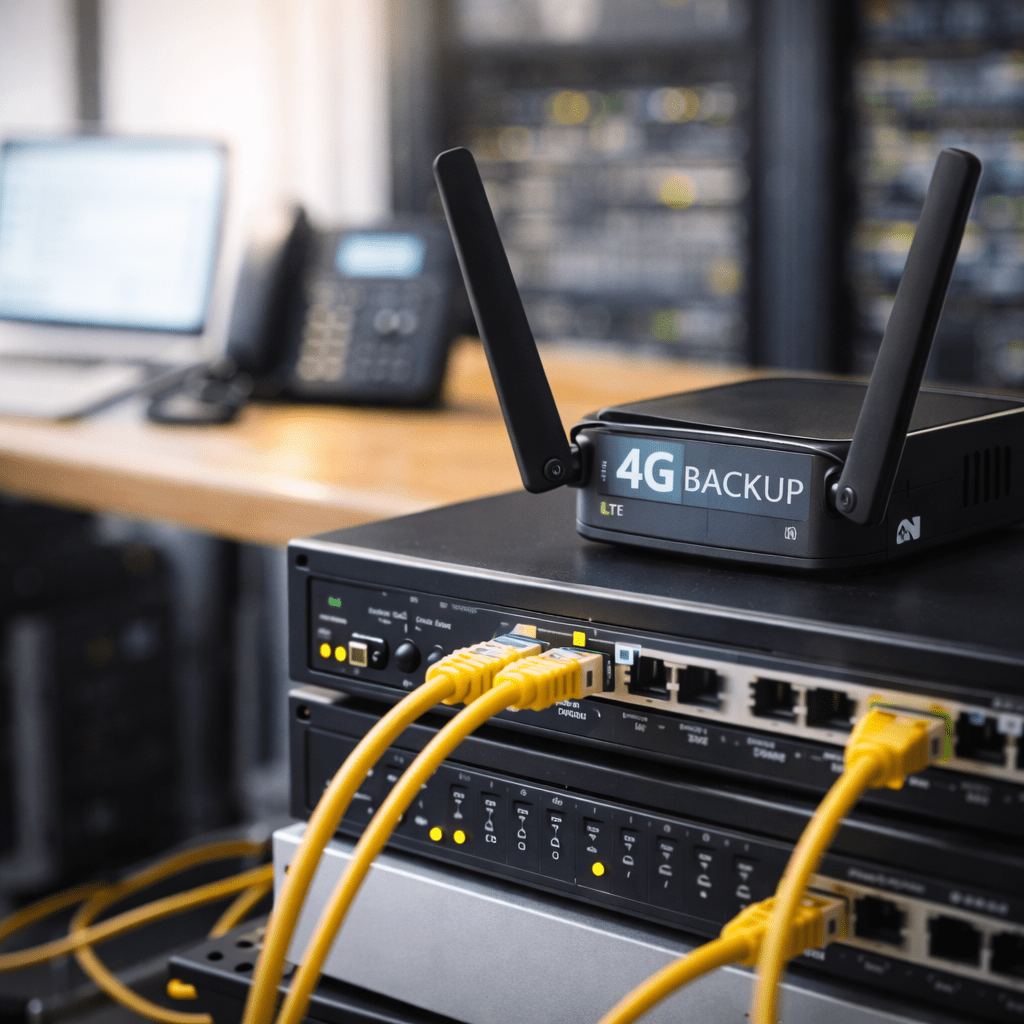
Backup connectivity provides a safety net. If the primary line fails, traffic can automatically switch to the secondary connection, allowing the business to continue operating.
Backup options can include:
- A secondary broadband connection
- A different network provider
- 4G or 5G mobile failover
- Dedicated failover routers
In many cases, the switch can happen automatically without staff needing to intervene.
Resilience Is Becoming the New Standard
Just as businesses insure their premises or back up their data, protecting connectivity is becoming a normal part of operational planning.
The question is no longer whether outages occur — but how prepared the business is when they do.
For organisations that rely heavily on online systems, having a backup connection is increasingly seen as sensible business continuity rather than an optional extra.
Planning Ahead
Every business is different, and the appropriate level of resilience depends on how critical connectivity is to day-to-day operations.
But for many organisations, the cost of a backup connection is small compared with the disruption caused by even a short outage.
Connectivity now sits at the heart of modern business.
Ensuring it remains available — even when problems arise — is simply good planning.
Rod Walker
Tel: 01482 291292
Email: rod@ktgl.co.uk
Web: http://www.ktgl.co.uk
#BusinessBroadband #Connectivity #BusinessContinuity #VoIP #LocalBusiness
 ktgl.co.uk
Leave a comment