
Broadband technology has moved on rapidly in recent years. Fibre networks are expanding, speeds have increased dramatically, and many businesses now rely heavily on cloud-based systems and internet communications.
Despite these changes, there are still a number of myths about broadband that continue to surface in conversations with businesses and homeowners alike.
Some of these ideas were once true, while others have simply developed through misunderstanding or outdated information.
Here are a few of the broadband myths I still hear surprisingly often in 2026.
Myth 1: Faster Broadband Always Fixes the Problem
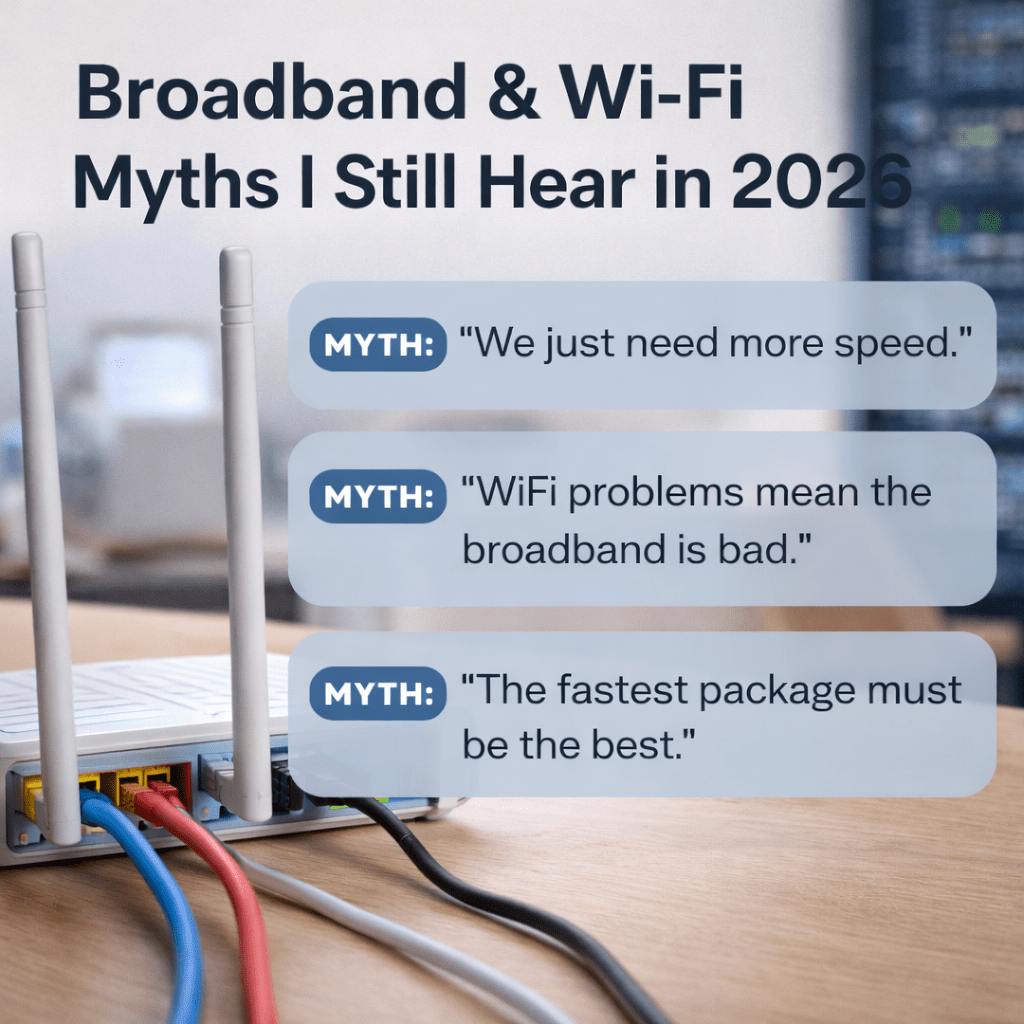
One of the most common assumptions is that if internet performance feels slow, the answer must be more speed.
In reality, speed is only one part of the picture.
Many performance issues are caused by factors such as:
- Poor WiFi coverage
- Outdated routers
- Network congestion inside the building
- Too many devices competing for bandwidth
Upgrading speed can sometimes mask these issues, but it does not always solve them.
Myth 2: WiFi and Broadband Are the Same Thing
Another common misunderstanding is that WiFi problems must be caused by the broadband connection.
Broadband is the connection coming into the building. WiFi is simply the wireless method used to distribute that connection internally.
If the WiFi coverage is weak, poorly positioned or overloaded, devices may struggle even though the broadband connection itself is perfectly healthy.
Myth 3: The Fastest Package Is Always the Best Choice
Marketing often focuses heavily on headline speeds, which can lead people to assume that the fastest available package must always be the best option.
In practice, the right connection depends on how the business actually uses the internet.
For many organisations, a well-configured connection with sensible speeds performs perfectly well. Reliability and good network design are often more important than maximum speed.
Myth 4: Internet Outages Are Rare Enough Not to Plan For
While broadband networks are generally reliable, outages can and do occur. Damage to fibre cables, equipment faults or infrastructure issues can interrupt service unexpectedly.
As businesses rely more heavily on internet connectivity for phones, payments and cloud systems, even a short outage can have a noticeable impact.
For this reason, some organisations now consider backup connectivity as part of sensible planning.
Myth 5: Once It’s Installed, It Never Needs Reviewing
Many businesses install broadband and then leave it untouched for years.
However, technology and business needs both change over time. What was appropriate when the connection was first installed may not be ideal several years later.
An occasional review helps ensure that the setup still supports the way the business operates.
A Changing Landscape
Broadband technology continues to evolve, and keeping up with these changes can sometimes be confusing.
Separating fact from myth helps businesses make better decisions about their connectivity and avoid unnecessary costs or frustrations.
As with most areas of technology, the best approach is usually a practical one: focus on reliability, suitability and sensible planning rather than simply chasing the latest headline figures.
Rod Walker
Tel: 01482 291292
Email: rod@ktgl.co.uk
Web: http://www.ktgl.co.uk
#Broadband #Connectivity #BusinessTechnology #VoIP #LocalBusiness #EastYorkshire
 ktgl.co.uk
Leave a comment