
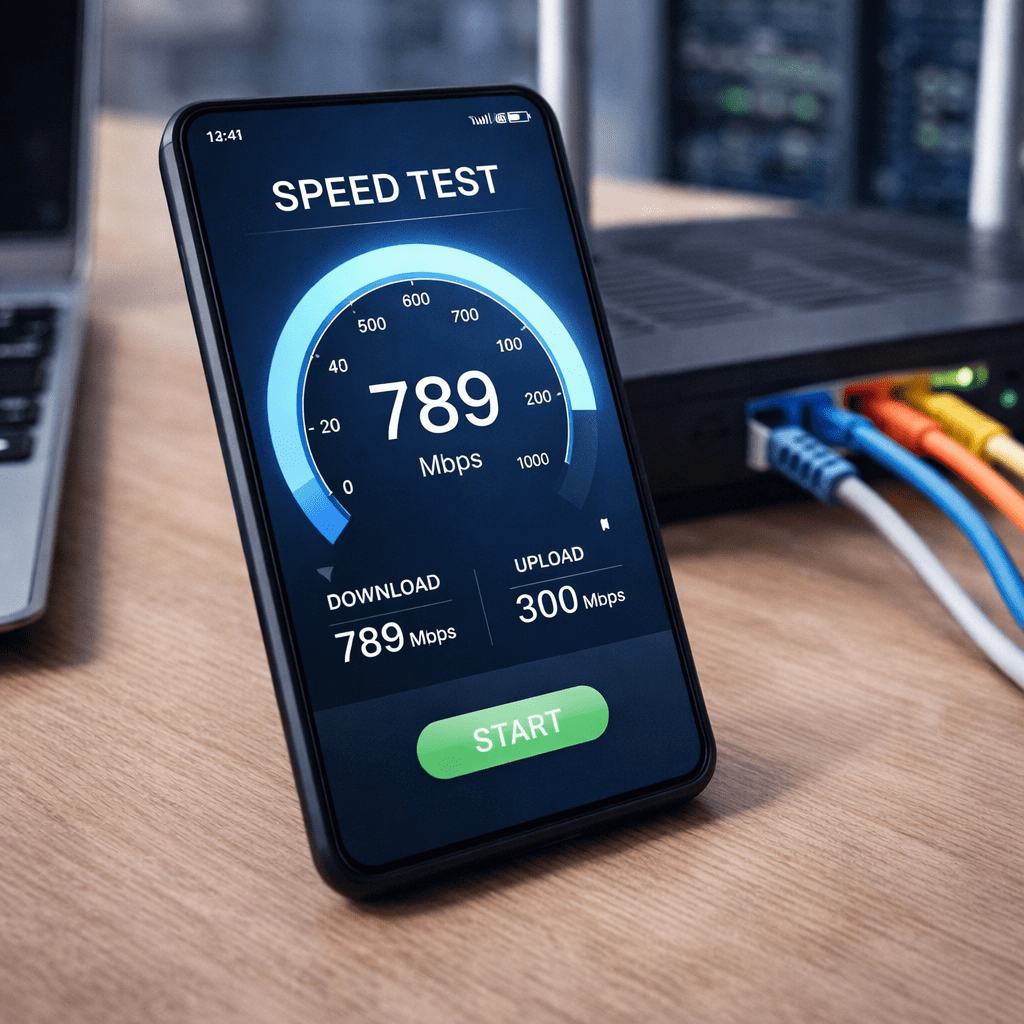
If you look at almost any broadband advert, one thing stands out immediately.
Speed.
Bigger numbers. Faster downloads. Gigabit connections.
It’s easy to see why. Speed is simple to understand and easy to compare. On paper, it feels like the most important factor when choosing a service.
But in day-to-day business use, speed is often the most over-emphasised — and sometimes the least understood — part of the equation.
Speed Is Only One Piece of the Puzzle
Broadband speed refers to how quickly data can be transferred.
It matters, of course. But for most businesses, the difference between very high speeds and sensible speeds is rarely noticeable during normal working activities.
Typical office tasks such as:
- web browsing
- cloud applications
- VoIP calls
do not require extreme bandwidth.
What they do require is consistency.
Reliability Matters More Than Raw Speed
A fast connection that drops out or fluctuates throughout the day is far more disruptive than a slightly slower connection that performs consistently.
In business, stability is what keeps systems running smoothly.
Reliable connectivity ensures:
- clear phone calls
- stable video meetings
- uninterrupted access to cloud systems
- consistent performance across the team
When reliability is in place, speed becomes far less of a concern.
Latency and Quality Are Often Overlooked
Another factor that rarely gets mentioned in marketing is latency — the delay between sending and receiving data.
Low latency is particularly important for:
- VoIP phone systems
- video conferencing
- real-time applications
A connection can have impressive headline speeds but still perform poorly if latency is high or inconsistent.
The Internal Network Is Just as Important
Many perceived “speed issues” actually originate within the business itself.
Common causes include:
- poor WiFi coverage
- outdated routers
- network congestion
- poorly configured equipment
Increasing broadband speed will not fix these problems.
A well-designed internal network often delivers a bigger improvement than upgrading to a faster package.
Matching the Connection to the Business
The right approach is not to choose the fastest available service, but to choose the most appropriate one.
This means considering:
- how many users are on the network
- what systems are being used
- whether voice services rely on the connection
- how critical uptime is to the business
For many organisations, a well-configured connection with sensible speeds is more than sufficient.
A More Practical View
Speed has become the headline feature in telecoms because it is easy to market.
But for most businesses, it is not the defining factor of a good connection.
Reliability, consistency, and proper network design usually have a far greater impact on day-to-day performance.
The goal is not to have the fastest connection on paper.
It is to have one that works smoothly, reliably and without interruption — every single day.
Rod Walker
Tel: 01482 291292
Email: rod@ktgl.co.uk
Web: http://www.ktgl.co.uk
#BusinessBroadband #Connectivity #VoIP #BusinessTechnology #LocalBusiness
 ktgl.co.uk
Leave a comment